The Eclipse Coincidence: Sun and Moon
It is a mathematical anomaly that allows for one of nature's most spectacular optical illusions: the Sun and the Moon appear exactly the same size in Earth's sky.
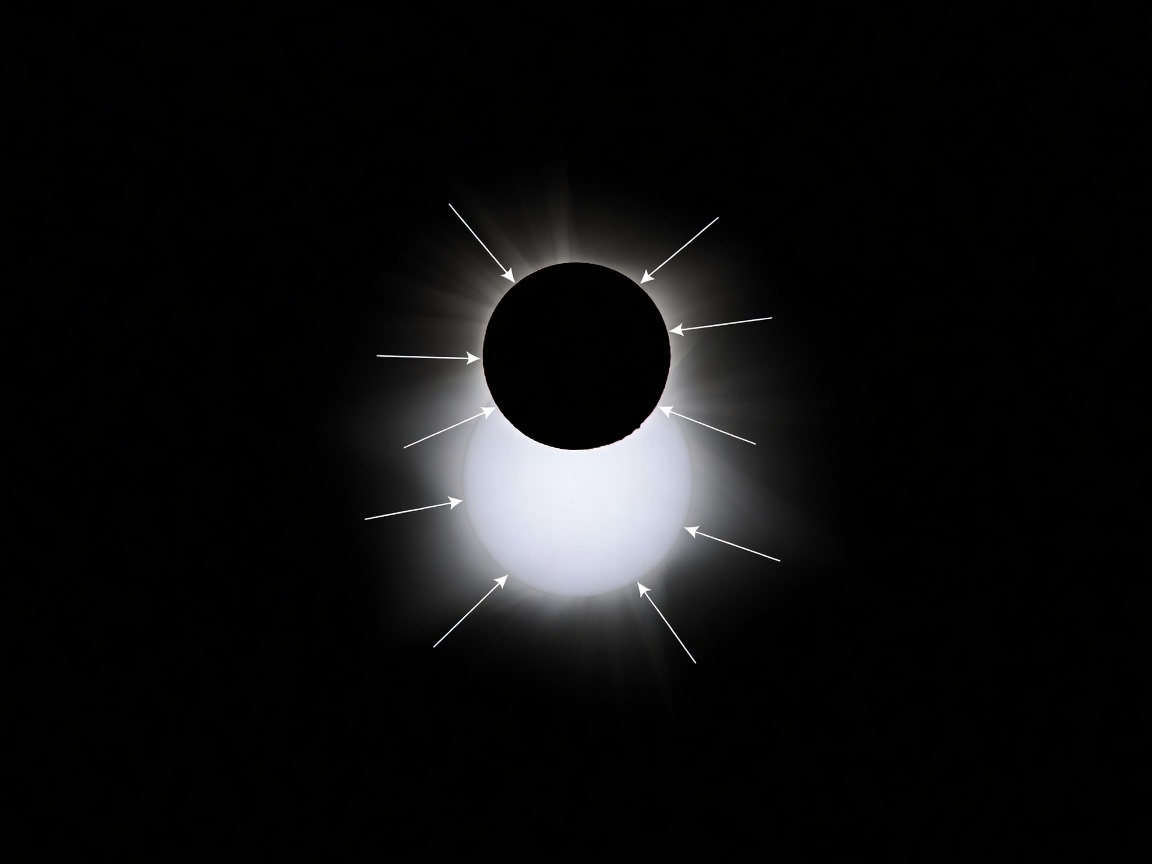
When we observe history, we typically look at timelines constructed over decades or centuries. But the grandest coincidence known to humanity operates on a geological, cosmic scale. It is a spatial and temporal anomaly so perfectly balanced that it has shaped human mythology, religion, and early astronomy. It is the reason we experience perfect total solar eclipses.
The 400 Ratio
The mathematics behind this cosmic coincidence are remarkably straightforward. The diameter of the Sun is approximately 1.4 million kilometres. The diameter of our Moon is just under 3,500 kilometres. If you do the math, the Sun is roughly 400 times wider than the Moon.
However, the Sun is also significantly further away. The distance from Earth to the Sun averages 150 million kilometres, while the distance to the Moon averages 384,400 kilometres. If you divide those two numbers, you find that the Sun is, astonishingly, about 400 times further away from Earth than the Moon is.
Because the ratio of their diameters perfectly matches the ratio of their distances, they have the exact same apparent angular size in our sky (approximately 0.5 degrees). When their orbits intersect perfectly, the tiny rock completely masks the gigantic star, revealing the Sun's ethereal corona without blinding the observer.
A Temporal Window
What makes this coincidence even more extraordinary is that we live in the exact epoch of Earth's history where it is visible. The Moon is not entirely stationary; due to tidal friction, it is slowly spiralling away from Earth at a rate of about 3.8 centimetres per year.
Billions of years ago, the Moon was much closer and appeared significantly larger in the sky, meaning it would block out the entire Sun and its corona during an eclipse, plunging the world into total, uninteresting darkness. Millions of years in the future, the Moon will have drifted too far away. It will appear too small to fully cover the solar disk, resulting only in annular (ring of fire) eclipses. The fact that conscious, observing humans evolved precisely during the cosmic window when the perfect geometric match occurs is a temporal coincidence of staggering proportions.
Cosmic Geometry
- 400x Ratio by which the Sun is larger than the Moon.
- 400x Ratio by which the Sun is further away from Earth.
- 3.8 cm Distance the Moon drifts away from Earth annually.
The Anthropic Principle
Astrophysicists and philosophers often point to the eclipse coincidence when discussing the "Anthropic Principle"—the philosophical consideration that observations of the universe must be compatible with the conscious life that observes it. Is there a physical reason for the 400x ratio, or is it merely random chance?
To date, there is no known physical law that dictates a planet's moon must perfectly match its star's angular size. If we look at the other planets in our solar system, none experience perfect eclipses like Earth. Mars' moons, Phobos and Deimos, are too small, looking like lumpy potatoes passing over the sun. Jupiter has dozens of moons of varying sizes, none of which perfectly occlude the solar disk from the surface.
The perfect solar eclipse stands as a beautiful, random gift of geometry. It reminds us that while the universe is governed by cold physics and vast, uncaring distances, it is still capable of generating breathtaking poetry purely by coincidence.