Mark Twain and Halley's Comet
The great American author Samuel Clemens claimed his life was cosmically tethered to the 75-year orbit of Halley's Comet. History proved him extraordinarily correct.
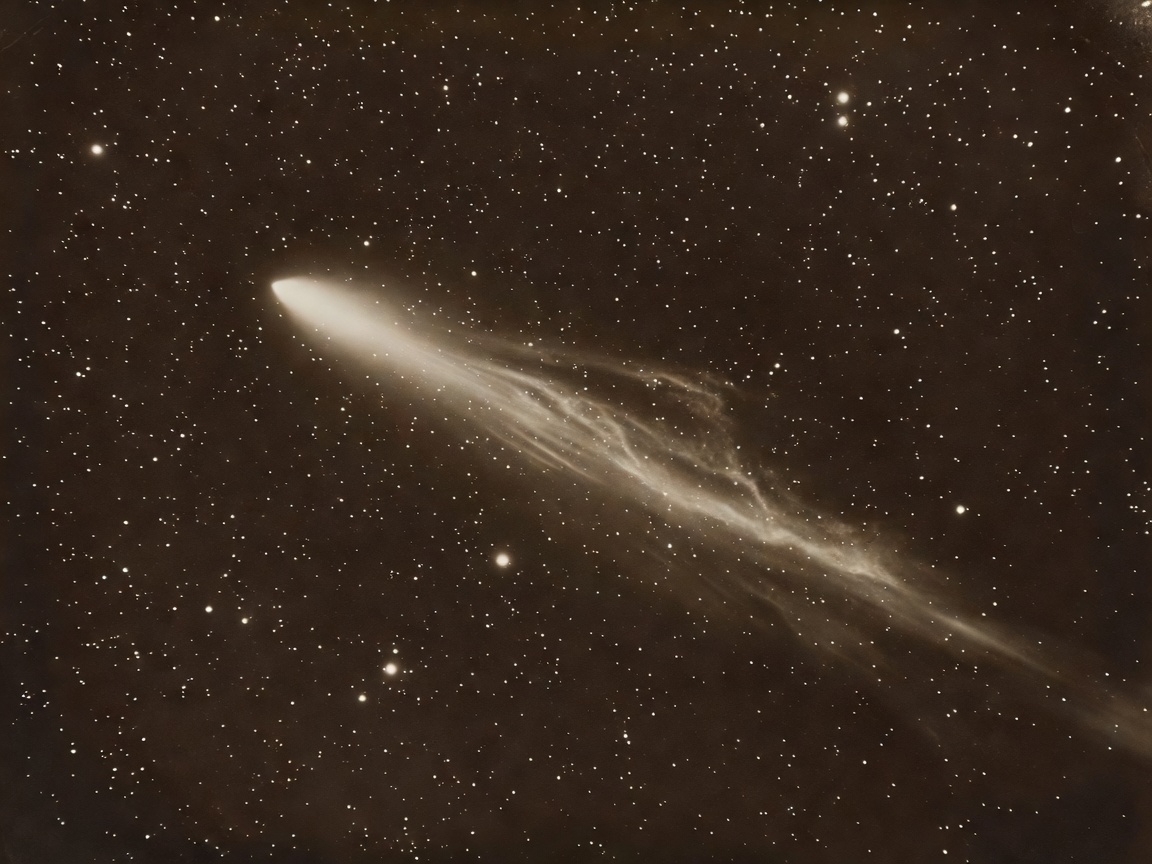
Of all the historical coincidences documented by biographers, few are as famously self-prophesied as the connection between Samuel Langhorne Clemens—better known by his pen name, Mark Twain—and the celestial phenomenon known as Halley's Comet. It is a story of astronomical timing, literary flair, and an eerie prediction that came true almost to the hour.
The 1835 Arrival
Halley's Comet is a "periodic" comet, meaning it follows an orbit that brings it past Earth on a predictable schedule, specifically every 75 to 76 years. On November 16, 1835, the comet reached its perihelion, the point in its orbit closest to the sun, making it brilliantly visible from Earth. Just fourteen days later, on November 30, 1835, Samuel Clemens was born in the small frontier settlement of Florida, Missouri.
Growing up, Twain was deeply aware of this cosmic synchronicity. His birth coinciding with the brilliant, fiery streak across the sky became a foundational part of his personal mythology. As he developed into one of America's most celebrated authors, humorists, and public intellectuals, he frequently referenced his celestial "twin" to friends and biographers.
The Great Prediction
In 1909, Twain was 74 years old. His health was failing, and he had suffered a series of devastating personal losses, including the deaths of his wife Olivia and two of his daughters. Knowing that Halley's Comet was due to return the following year, Twain made a profound, fatalistic statement to his biographer, Albert Bigelow Paine.
Twain famously declared: "I came in with Halley's Comet in 1835. It is coming again next year, and I expect to go out with it. It will be the greatest disappointment of my life if I don't go out with Halley's Comet. The Almighty has said, no doubt: 'Now here are these two unaccountable freaks; they came in together, they must go out together.'"
The 1910 Departure
As 1910 dawned, astronomical observatories worldwide eagerly tracked the return of Halley's Comet. On April 20, 1910, the comet reached its perihelion once again, blazing across the night sky in a magnificent display.
The very next day, on April 21, 1910, Mark Twain suffered a fatal heart attack in Redding, Connecticut. He died exactly as he had predicted: departing the world in tandem with the celestial visitor that had heralded his arrival 74 years earlier.
The Timeline
- Nov 16, 1835 Halley's Comet reaches perihelion.
- Nov 30, 1835 Samuel Clemens (Mark Twain) is born.
- Apr 20, 1910 Halley's Comet reaches perihelion again.
- Apr 21, 1910 Mark Twain passes away.
The Meaning of the Meteor
Was this purely an astronomical coincidence? Statistically, yes. But to view it merely as a statistical anomaly is to strip the story of its literary soul. Twain understood the power of narrative. By openly tying his mortality to the orbit of a comet, he transformed a biological inevitability into a poetic legend.
The timing of Twain's death stands as a remarkable example of how history occasionally aligns perfectly with human romanticism. While no scientific evidence suggests that human lives are tied to the paths of comets, Mark Twain’s story remains an exception that proves the rule—a beautiful, verified historical synchronicity that feels authored by the universe itself.